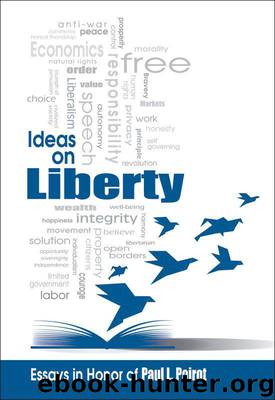
Ideas on Liberty: Essays in Honor of Paul L. Poirot by Paul L. Poirot
Author:Paul L. Poirot
Language: eng
Format: mobi
ISBN: 9781610165617
Publisher: Mises Institute
Published: 2012-08-31T05:00:00+00:00
Seeking the Ultimate Source of Our Liberties
To say that the law is the guarantor of our liberties, it must be emphasized, is not to say that it is also the ultimate source. That source is as inscrutable as the prime mover of the universe. We can verbalize the obscurity—trace it back into the human mind, the human spirit, the “soul,” if you prefer. I have myself said that freedom, well-being, and security are the built-in, the ultimate, human values. (See The Labor Policy of the Free Society [1957].) But I believe that objective, nonmetaphysical analysis must stop with some such self-evident postulate. We are capable of such words and ideas as “God,” “nature,” “divine consciousness,” but they seem to me to be invitations to argument rather than clarifications. Efforts by Nozick and Epstein to trace back property and contract and liberty to more primal sources seem to me to be bootless whistling in the dark.
In any event, I content myself here with the profound concept of the commonwealth stated by Dante Alighieri in De Monarchia—“The aim of rightful commonwealths is liberty, to wit that men may live for their own sake,” and with the intimately related definition of law offered by Thomas Aquinas: “an ordinance of reason directed to the common good,” with the common good being defined as freedom, well-being, and security, the ends that Western man has sought.
Reflection on this conception of law and the common good suggests that the “fumbling around” theory of legal development associated with Edmund Burke and Friedrich Hayek does not amount to much. Certainly, no one can deny that the legal institutions and principles of the Western world have had their ups and downs; or that it has taken centuries for them to fix on a direction and to follow it with some consistency. But no one in his right mind expects perfection from any human being or any institution—in any field of human action. Of course, the law has fumbled around. But fumbling, too, can be a rational activity; trial and error is not only a rational methodology, it is about the best and most rational one available to mankind, in all areas of human action, including “scientific” laboratories.
Bear in mind here the remarkable fact that all over the West the legal institutions came roughly to the same conclusions at roughly the same time. In all Western countries, the “common good” to which their reason directed them was freedom and its handmaidens, property and contract, good not only in themselves but also in the well-being and security they promoted by way of increasingly free markets. The actual historical process was endlessly complicated, tragic, full of false moves, crammed with good results from bad motives and bad results from well-motivated actions. And yet, from it all, there emerged the most useful and productive juridical principles ever conceived: private property and freedom of contract.
Sir Henry Maine was simply summing up these developments when he said that “the movement in the progressive societies has hitherto been a movement from status to contract.
Download
This site does not store any files on its server. We only index and link to content provided by other sites. Please contact the content providers to delete copyright contents if any and email us, we'll remove relevant links or contents immediately.
The Brazilian Economy since the Great Financial Crisis of 20072008 by Philip Arestis Carolina Troncoso Baltar & Daniela Magalhães Prates(141443)
International Integration of the Brazilian Economy by Elias C. Grivoyannis(111079)
The Art of Coaching by Elena Aguilar(53275)
Flexible Working by Dale Gemma;(23295)
How to Stop Living Paycheck to Paycheck by Avery Breyer(19736)
The Acquirer's Multiple: How the Billionaire Contrarians of Deep Value Beat the Market by Tobias Carlisle(12334)
Thinking, Fast and Slow by Kahneman Daniel(12319)
The Radium Girls by Kate Moore(12036)
The Art of Thinking Clearly by Rolf Dobelli(10496)
Hit Refresh by Satya Nadella(9141)
The Compound Effect by Darren Hardy(8978)
Tools of Titans by Timothy Ferriss(8403)
Atomic Habits: Tiny Changes, Remarkable Results by James Clear(8350)
Turbulence by E. J. Noyes(8057)
A Court of Wings and Ruin by Sarah J. Maas(7859)
Change Your Questions, Change Your Life by Marilee Adams(7788)
Nudge - Improving Decisions about Health, Wealth, and Happiness by Thaler Sunstein(7712)
How to Be a Bawse: A Guide to Conquering Life by Lilly Singh(7495)
Win Bigly by Scott Adams(7204)
